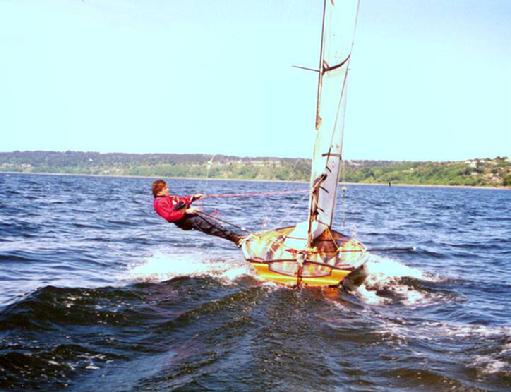
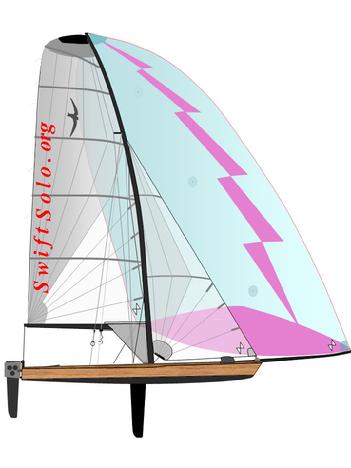
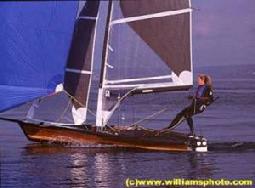
Three sail skiff racing is the future of single-handed sailing
Why opt to sail a single-hander with three sails? It’s got to be heavier, more expensive, and more complicated than a single-hander with a main and spinnaker. Dealing with the jib during rigging has got to take longer and trimming it and two other sails on the water, single-handed, has to require skills beyond extraordinary. Right?
Maybe the place to start is to first discuss issues with two sail single-handers. Cat rigged boats have been around since the beginning. The principle was fairly simple. Put a sail up a mast, place a keel or centerboard below a point approximately centered on the sail and add a rudder to provide directional control. While boats with multiple crew members largely abandoned this design well over a century ago, this has been the standard of single-handed sailing right up till a couple of years ago. Recently, however, a handful of sailors came on the scene with a low threshold of boredom. Certain that there had to be more exciting ways to sail a boat alone—especially downwind, they added a spinnaker to the mix.
Cat rigged boats traditionally had the mast well forward for balance but when the spinnaker was added it became apparent that this was not a good idea because of the tendency to make the bow dive like a submarine. To compound the dilemma, skiff designers had discovered the speed advantage of needle-nosed bows—not friendly to forward centers of effort typical of these boats. Mitigation of this problem required a combination of changes. First they moved the mast aft and the centerboard far aft. By staying with rather small fractional spinnakers they could keep the center of effort lower to help reduce the nose diving problem. What they ended up with was a boat that is fairly fast to weather and acceptably fast down wind. Because the rudder and centerboard are close together, the amount of momentum lost tacking and steering through waves is high (very short lever turning a long resistant waterline) so these boats are not tactical. Additionally, the propensity for the rudder to wash out is high. At the end of the day, the compromises made these boats quite difficult to sail but certainly a lot more fun than their predecessors without kites.
The entire approach was based on the age old theory that single-handed sailing necessitated using cat rigged boats. While at least one single-hander (the International Canoe) had dared to challenge this one sail rule with the use of a jib, nobody had become serious about developing a three sail single-handed trapeze skiff.
In July of 1999, after a day of competing in a 49er regatta in the Columbia River Gorge, I watched Kris Henderson sail his 49er alone in about 4 knots of wind. Kris had obviously been doing this for some time and I was taken by how fast a 49er can move in really light air with just one person on board. Since the jib was self tacking, he kept the main and spinnaker sheets in one hand and was able to jibe quite easily. It occurred to me that with a cleating system on the boom for the mainsheet and single sheeting system that controlled both jib and main he would be able to concentrate on flying the kite from the wire. Because of the huge asymmetrical kite the main has to be sheeted nearly to the centerline downwind anyway and it becomes fairly irrelevant as long as it’s far enough in to keep it from luffing.
Shortly after that regatta, I cut about 38” out of one of my 49er masts, cut down some old 49er sails and began experimenting single-handed in my 49er. While the boat was really difficult to right from a turtle, I learned a lot about beam/sail area ratios since I could move the wings in and out. I also measured and recorded the sheets movement and relativity of the main and jib. Because the main moves in a fairly simple in and out direction and the jib in a very non-linier fashion the solution to the problem of sheeting them from a single sheet was baffling. On New Years morning 2000 I was awakened by some rather delayed fireworks at about 3am and as I lay in bed contemplating the problem, I realized that I’d been approaching the problem from the wrong direction entirely. The solution was obvious. I needed to use the changing transom bridle angle on the mainsheet to make it mirror the non-linier movement of the jib sheet. Using different purchase on each of the two sails combined with the right bridle base width and height, I thought it might be possible. I spent New Years day doing the calculations and designing the system on my computer. The system would work, at least in theory. I began designing the Swift Solo and started construction shortly thereafter. I tried the system for the first time in the spring of 2001. The sails maintained proper relativity right through a broad reach. While I’ve changed some minor things on the sheeting system since then, the theory was correct. The primary deterrent to having a jib on a single-hander is gone as it is both self-tacking and self-sheeting. Adding a jib no longer requires an additional hand.
Admittedly, the jib adds 18 blocks and four clam cleats to the boat. Three of the blocks and a clam are in the jib tack downhaul, four blocks and a clam are in the halyard, and four blocks and two clams are in the relativity control. That leaves seven blocks in the actual jib sheet before it is spliced into the mainsheet. The speed, balance, and ease of handling resulting from adding a jib far outweighs the cost.
In Summary, the odds that cat rigged boats with spinnakers will fade from the single-handed scene are fairly high, I think. Sailing a skiff without a jib is both slower and more difficult—especially when a spinnaker is added.
As a side note, my experiments and research have taken me to some conclusions regarding the point where reduction of weight and the subsequent loss of momentum no longer produce desirable results in winds over 15 knots. With some small adjustments for changes in sailing skill, mast drag, and hull rotational drag, sail area to weather must not exceed about 40% of the sailing weight of a sloop rigged trapeze skiff and crew (sail area in square feet and weight in pounds). When this rule is violated, expect a skiff to become non-tactical to weather as the loss in speed and time outweighs typical gains associated with wind shifts in short course racing. Cat rigs likely reduce the ratio to 32% and even less if the boom is low or the sailor is required to move aft during tacks (increased time required to get from wire to wire).
Bram
|