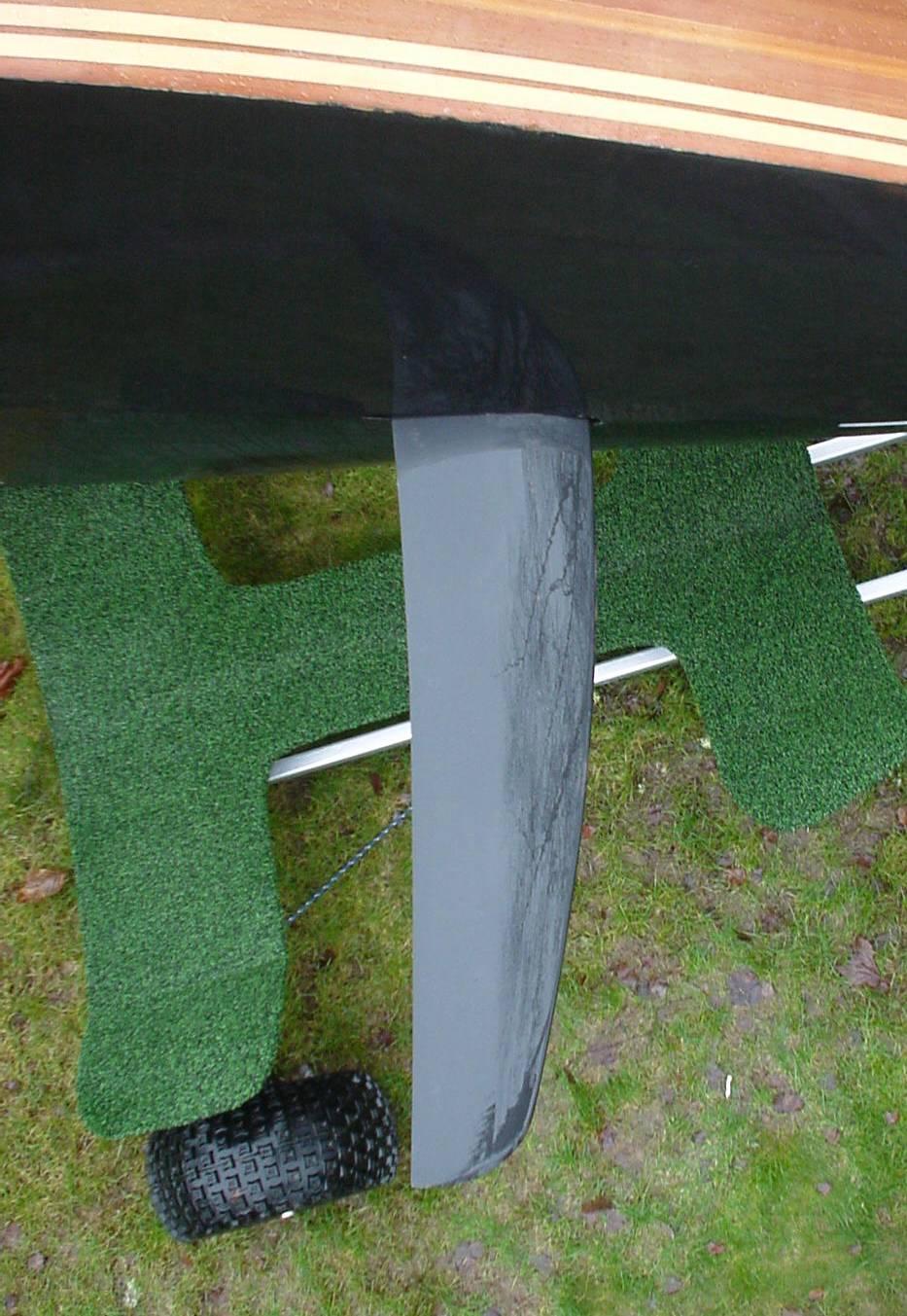
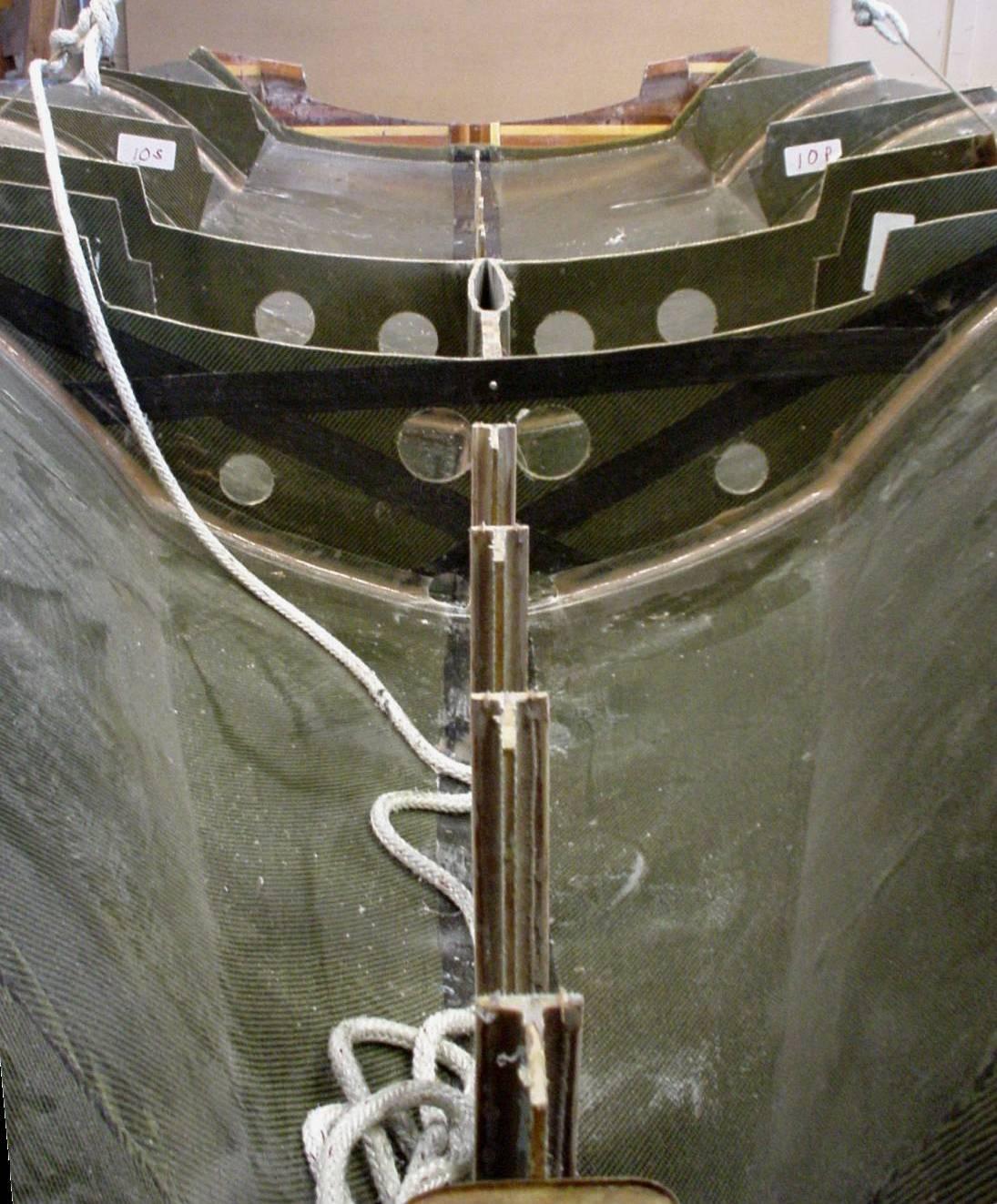
Good news! We’ve completed several stages of our sample testing for our new composite hulls and have learned a great deal. We have a large variation of composite samples to test but for now I will give you the results of the samples that we will most likely use on the Swift Solo and a couple of samples from a 49er hull. TESTING FOR FLEX, STRENGTH, AND IMPACT RESISTANCE Let me set the stage by explaining the samples: 1. The 49er is made of an e-glass /foam/ epoxy composite that is superior to most of the commercially available skiffs that are produced in quantity. Many skiffs use polyester resin which is inferior and less expensive. The 49er hull composite is a bit tougher below the chine and on the deck than the area right above the chine. Samples were taken and tested from all three areas, however, the results were best in the hull bottom samples and are recorded below. 2. The Swift Solo hull samples are e-glass/Kevlar/Nomex/carbon composite for the crush test and the same with a layer of e-glass over the carbon for the stiffness/failure test. The later composite will be used on the Swift in areas where bulkheads load the hull and the former in the other areas. In other words, a layer of e-glass will be added on the inside of the hull in the bulkhead areas (final determination remains subject to our flex cycle testing producing the results that we expect). 3. The Swift Solo deck samples are S-glass/cedar/carbon Kevlar hybrid with WEST System epoxy instead of Gougeon's Pro Set as was used on the hull samples. Testing methodology: Crush/Dent testing loads were recorded by using a digital scale mounted on a drill press table. A circular socket 3/8” in diameter was inserted in the chuck and the samples were placed flat on the scale and loaded evenly with the socket (see picture above). Each test measured the recorded load when gelcoat failure first appeared and again at total skin failure and penetration. Each sample was tested ten times and the results averaged. All samples were 12” x 12” in order to compare the relative weight of the composite. The Stiffness/Failure test was complete on 1” wide by 24” long samples of the same two composites (49er bottom composite and Swift Solo composite). The samples were suspended horizontally between two surfaces 19” apart. A hanging scale was used to measure the center span load at failure. In a separate test 7 lbs (plus the 9 lb. scale) was hung from the center of the span and deflection was measured on both samples (see pictures below). Results: Crush/Dent testing: The 49er hull bottom samples experienced gelcoat cracking at 158 lbs and complete failure at 223. The 12x12 sample weighs 278 grams (some 49er samples go as low as 242 grams). The Swift Solo hull samples experienced neither vissable gelcoat cracking nor puncture at 308 lbs. which is as high as my scale would record. Permanent indentations averaging .016 deep were left in the surface (the thickness of a calling card). The 12x12 sample weighs 196 grams. The Swift Solo deck samples experienced no surface cracking or indentation at 308 lbs. A blemish was left in the clear epoxy finish but easily removed with wet sanding. The 12 x 12 sample weight 340 grams Stiffness/Failure testing: The 49er hull bottom sample strip deflected 1 5/8” in the 7 pound test (actually 16 lbs) and failed completely at 31 pounds (tension side). This sample weighs 45 grams The Swift Solo hull sample strip deflected ¾” in the 7 pound test and failed completely at 44 lbs (compression side). This sample weighs 38 grams Conclusions: While this testing has produced impressive results for both the Nomex cored composite and the cedar cored deck composite, it is important to understand that the more significant results will come from the testing to be completed by Gougeon. That testing will measure the comparative stiffness degradation of the composite samples over thousands of flex cycles. We believe that it is this factor, more than any other, that explains why most high performance boats lose their competitive edge in a relatively short period of time. Our testing does serve to demonstrate the relative durability of the surfaces which is particularly important in high performance single-handers because of problems associated with handling the boat alone. The Swift Solo composite is significantly lighter, stronger, and more dent resistant than the 49er composite. It is also, however, much more expensive to produce than the 49er composite. Look for final testing results and production information soon. TESTING FOR WATER ABSORPTION AND/OR RETENTION Water Absorption Testing The samples: I used three samples to test for water absorption. One was a Balsa cored sample with two layers of 9 oz. e-glass on both sides. The second was a 49er hull sample with foam core and e-glass on both sides. The third was a Nomex cored sample with 5 oz. Kevlar and 9 oz. e-glass on one side and just 2 layers of 9 oz. e-glass on the other. All samples were 12” x 12” with raw unsealed edges. Testing methodology: All three samples were submerged in 72f water for 12 hours. The samples were removed from the water and stood on edge for drying at 72f for one hour with free air circulation on all sides and with shims to allow the bottom edge of each sample to drain freely. No forced air was used for drying. The thinking here is that it would take from one day to perhaps a week or longer for the inside of a typically ventilated skiff hull to dry out to the same level. The Results: The Balsa sample weighed 331 grams prior to submersion and 331.5 after an hour of drying. The 49er sample weighed 264.5 grams prior to submersion and 272 grams after an hour of drying. The Nomex sample weighed 254.5 grams both before submersion and after an hour of drying. Conclusions: Some of my previously held prejudices have been destroyed. The Balsa sample did not swell, degrade, nor did it suck up the quantity of water I had expected. In discussing this with Larry Tuttle he believes (and the results support) that Balsa does not transfer water across the grain well—only along its length. Unless the skin becomes delaminated, water absorption is not likely to be much of a problem from fitting penetrations that are prepared with even minimal care. This removes one of my major concerns about using this core material, the other being weight. The 49er sample had by far the largest weight gain (7.5 grams) which was well outside of my expectations. The inside of this sample lacks any kind of finish seal coat and judging from the cool, clammy feeling after the hour of drying, I believe that this moisture weight is in the weave voids of the cloth and not the foam. Continued drying over the next 12 hours brought the sample within .5 grams of the weight prior to submersion. The Nomex sample had no weight gain—completely blowing apart what I expected to be its’ weakness. The bottom line continues to support the superiority of Nomex as a core material for our hulls. Because of the design of the Swift Solo, the heavy loads on the hull are in tension. Certainly substantial loading occurs from wave cycles, however, most of this harsh water impact loading happens from the centerboard forward. This is the same area where tension loads from the rig are the highest and those loads tend to help minimize deflection (compression loads would increase deflection). The deck is the area is where compression loads are very high and where we believe that our cedar cored samples will likely show the lowest level of degradation at the end of our flex testing cycles. The outcome sought from all of this testing is to produce a boat that will be just as fast after many years of racing as it is the day it is launched. By spending more money on the right materials, the right builders, and the right storage environment (dock dolly and boat cover) it will be possible to bring the long-term cost of skiff sailing down significantly from the current standards. Bram
|