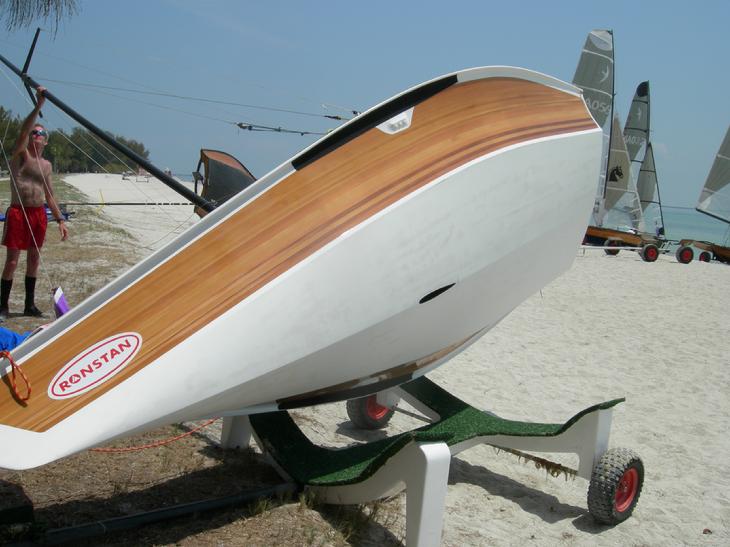
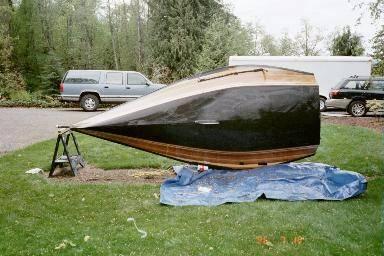
Chine entry angle only 2 degrees wider than a 49er. A Ken Bradon Photo
HOW THEY MEASURE UP
Compare the waterline to the overall width.
Boat
SWIFT SOLO
Musto
RS 700
Length
4.41 m
4.55 m
4.68 m
Width
1.95 m
2.35 m
1.92-2.33 m
Mainsail Area
9.97 sq m
11.8 sq m
12.8 sq m
Jib Area
4.17 sq m
NONE
NONE
Gennaker Area
24.69 sq m
15.5 sq m
16 sq m
Total Sail Area
38.83 sq m
27.3 sq m
28.8 sq m
Hull Complete
77kg
55 kg
56 kg
All Up Weight
89kg
80 kg
79 kg
Material Hull
s-glass/cedar core/ carbon/kevlar
e-glass/foam core
e-glass/foam core
Material Spars
Carbon
Carbon
Carbon
A CLOSER LOOK
Since the 24 1/2er (The Swift Solo) has the largest sail plan of any of the skiffs on the chart, it would be easy to conclude that such a massive sail area would make the boat difficult to sail. One look at the size of the spinnaker alone might be enough to scare away even hardcore skiff sailors. A few minutes in the boat will change these perceptions. While this is not intended to be an entry-level skiff, I believe that any intermediate skiff sailor with trapeze experience will catch on to sailing this boat rapidly. A systematic approach to learning to sail the boat in increasing wind speeds will take good skiff sailors rapidly to the 20-knot range.
Originally this design was intended as a single-handed trainer for 49er sailing. It has turned out to be much more.
How does it feel?
TO WEATHER In light air the boat feels very much like the 49er. Body movement on the trapeze mimics 49er sailing quite well and teaches good habits for 49er sailors. In 12 to 17 knots the 24 1/2er is a dream to sail. The combination hull design and the mainsheet/jib sheet system make easy work of gust/lull cycles. You can lower yourself right down on the wire. Because the jib and main operate from a single sheet, the boat simply accelerates when eased during a gust instead of staggering. I would love to put this system on my 49er. (Think about it----the jib and main ease and the slot opens accurately at precisely the same time.) It took watching Julian sail this boat to make me realize that I was trapping way higher than necessary. After 20 minutes in the boat he was parallel to the water all of the time.
BEARING OFF The 24 1/2er is as nearly an exact duplicate of the 49er as I could have hoped for. In above 15 knots you MUST blow the vang, move a bit aft, and be aggressive. It helps if you've raised the board a bit for going to weather before the bear-away.
HOISTING The boat is very manageable during the hoist and the spinnaker system has little friction. I will be making a CD video with Wink's help that will show a technique that allows you to keep the boat heated up a bit during both the hoist and the douse. Jibe-sets work very well also.
THE RIDE The transition to the wire after the hoist is very easy. The chute is choked and the Main/jib sheet is pulled in to the approximate setting before heading out. As you let slack in the spin sheet the boat begins to power up. At that point you simply stop letting out slack and head out while heating the boat up. It accelerates like a rocket and, with practice; you will find that the apparent wind comes forward the right amount to compensate for the inward sheeting that occurred as you headed out. No lee helm or other problems on the ride. Simple stay aft, steer to keep the boat under the rig and everything is so fast and exciting and that you're tempted to simply keep going. You can pretty much sheet and forget the main/jib unless the wind speed changes a significant amount-even then, you will notice little difference in speed because the spinnaker is doing the work.
THE JIBE The boat behaves very nicely as you swing in and jibe the chute. You simply leave the main/jib sheet cleated and deal with the chute. Grab the new spinnaker sheet at the block and pull in about six feet of sheet (this will keep the chute from hour-glassing and choke it as well. With practice the chute remains full and the process takes about the same amount of time as on a 49er. On the new tack now, you ease the spinnaker sheet to power up the boat. Take the sheet with you as you go out on the wire and heat it up. The apparent wind will move forward enough to cause the sheet to be approximately correct in your hand again.
DOUSING Almost no friction because of the oversized sock----very quick and easy.
ROUNDING UP Nearly identical to the 49er, wind speed by wind speed. The boat accelerates quickly because of the synchronized trimming of both sails. HANDLING ON THE DOCK OR SHORE I launch and pull the boat up on the dock by myself without any problem. You do need a line hooked to your launching dolly so that someone on shore can pull it out without getting wet after you launch from shore. The boat stands by itself quite nicely without sails up and is substantially more stable than the 49er while getting underway.
I will continue to have the other top sailors give their opinions as they take turns sailing the boat.
TESTING YOUR KNOWLEDGE
Rate the four boats below in order of power to weight ratios (sail area to sailing weight) going to weather. Assume all crew members weigh 175lbs.
Use the same rating system for these boats downwind (with the kite up).
Answers at the bottom of the page
Swift Solo
49er
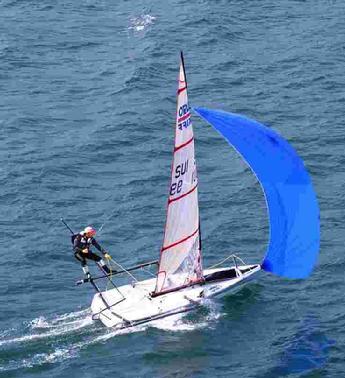
Musto skiff
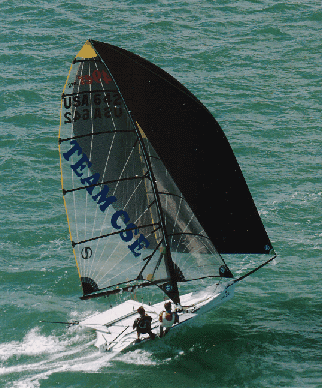
Charlie, putting it through the paces
Answers to the questions above:
Swift Solo .41, Eighteen footer .37, 49er .35, Musto skiff .32
Swift Solo 1.04, 49er 1.0, Eighteen footer .97, Musto skiff .73